
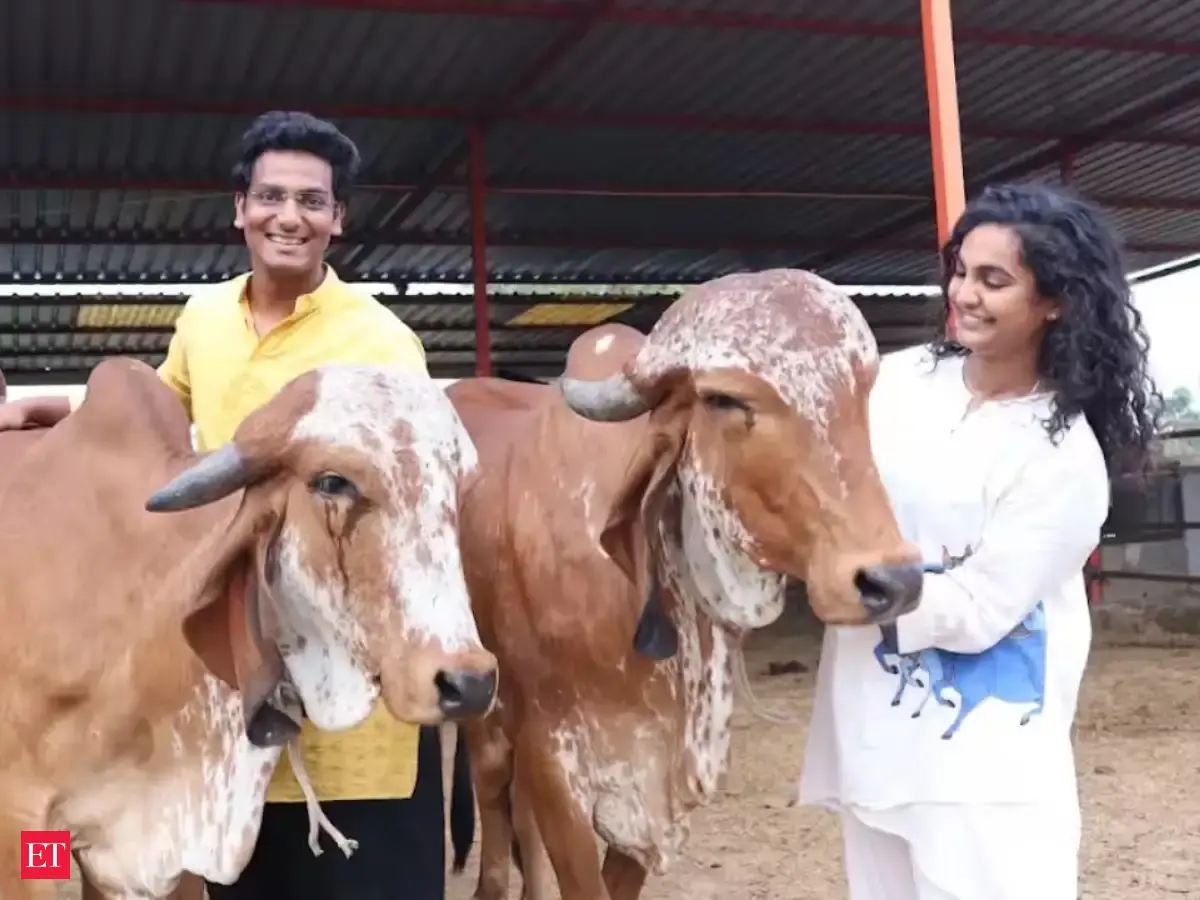
Jaipur-based couple Vibhor and Ishita Jain started Kinaya Organic Farms and Life in 2018 with 20 rented Gir cows. Today, the venture has grown into an integrated farming business with 100 Gir cows, over 2,000 trees and a reported annual revenue run-rate of up to Rs 2.4 crore.
Jaipur-based couple Vibhor and Ishita Jain started Kinaya Organic Farms and Life in 2018 with 20 rented Gir cows. Today, the venture has grown into an integrated farming business with 100 Gir cows, over 2,000 trees and a reported annual revenue run-rate of up to Rs 2.4 crore. The farm combines dairy production, value-added products, agroforestry, biogas, solar power and rainwater harvesting.
Starting a farm without agricultural experience can be challenging, particularly when it involves livestock, land management and building a customer base. For Jaipur-based couple Vibhor Jain and Ishita Jain, the journey began in 2018 with Gir cows and a willingness to learn farming from scratch. Today, their venture, Kinaya Organic Farms and Life, has grown into an integrated farming business with 100 Gir cows, more than 2,000 trees and an annual revenue run-rate of up to Rs 2.4 crore, according to a report by Navbharat Times. Located around 35 km from Jaipur, the farm produces milk, traditional ghee and several other products. Its operations also bring together organic cultivation, agroforestry, biogas, solar power and rainwater harvesting. Rather than relying on dairy sales alone, the couple have developed a business in which livestock, agriculture and resource management work together.
From a computer science graduate to a Gir cow farmerVibhor Jain's journey into farming began well before Kinaya Farms was established. A computer science engineering graduate who studied in Bengaluru, he did not have a conventional agricultural background. His interest in indigenous cattle grew after his family brought two cows home.
According to Kinaya Farms' official website, Vibhor travelled to Kathiawar in Gujarat in 2017 to learn about Gir cows and traditional cattle-rearing practices from families with generations of experience. The visit helped him understand indigenous cattle farming and the challenges of connecting quality dairy products with urban consumers.
In 2018, he took land on lease near Jaipur and began the venture with 20 Gir cows. The early years involved learning the practical aspects of animal husbandry, dairy management and sales. Instead of immediately expanding into multiple agricultural activities, he spent the initial three years developing the dairy operation and understanding how to run the business.
The venture subsequently grew beyond its original focus on milk production.
How Ishita Jain joined the farming businessIshita Jain joined Vibhor in the venture after their marriage in 2022. She holds an engineering degree in Information Technology and an MBA in Human Resources.
Her involvement contributed to the development and management of the business as the farm expanded its operations. What began as a dairy venture gradually evolved into a broader agricultural enterprise, bringing together livestock, food processing and cultivation.
The couple's approach was to build different income streams around the farm rather than depend on a single product category.
Kinaya Farms expands beyond dairy farmingKinaya Organic Farms and Life has grown to include dairy production, fruit cultivation, agroforestry and other agricultural activities. The property has more than 2,000 trees, including over 500 mango trees representing around 40 varieties, as well as more than 25 other types of fruit trees and over 300 white sandalwood trees.
This diversification gives the farm a role beyond milk production. Fruit cultivation and other crops form part of its wider agricultural operations, while the trees contribute to its agroforestry model.
The expansion also reflects a shift in how the couple manage the farm. Livestock, trees, soil and energy are treated as interconnected parts of the operation rather than separate activities.
How cow dung is turned into biogas and fertiliserOne of the distinctive features of Kinaya Farms is its use of cow dung as a resource.
The farm uses dung to produce biogas, which supplies cooking gas on the property. The material left after the biogas process is used as fertiliser for the fields, helping return nutrients to the soil.
According to Kinaya Farms' official website, the facility has a 15-cubic-metre biodigester. The system forms part of its effort to reduce waste and make use of resources generated by its own livestock.
This approach links dairy farming with crop cultivation. The cows provide milk for sale and processing, while their dung supports energy production and fertilisation. The farm's regenerative organic farming practices are intended to improve soil health and reduce reliance on external inputs.
Solar power and rainwater harvesting support farm operationsEnergy and water management are also central to the farm's operating model.
Kinaya Farms has a 45-kilowatt solar power installation to generate electricity. It also uses rainwater harvesting to collect and store water, while drip irrigation helps supply water to fruit trees and vegetables more efficiently.
A report by The Better India has cited a rainwater-harvesting reservoir with a stated capacity of 50 lakh litres at the farm. Electric vehicles are also used in its operations.
Together, these measures help the farm manage some of its energy and water requirements on site. However, the extent of its overall self-sufficiency depends on factors such as seasonal rainfall, energy demand and the scale of its operations.
100 Gir cows produce up to 300 litres of milk a dayThe dairy operation has expanded from its initial 20 cows to a herd of 100 Gir cows. The farm produces approximately 250-300 litres of milk a day, according to the information provided about its operations.
Some of the milk is sold as liquid milk, while the remainder is processed into traditional bilona ghee. Production is reported to be around nine litres of ghee a day.
Kinaya Farms has also diversified into wood-pressed oils, organic vegetables and freeze-dried products, including colostrum powder. Its product portfolio includes more than 25 items, allowing the business to serve customers beyond those buying fresh milk.
Processing milk into ghee and other products gives the venture additional ways to generate revenue from its dairy operations. The wider range of agricultural and food products also reduces its dependence on selling milk alone, although individual product sales and profitability may vary.
Kinaya Farms' revenue reaches up to Rs 2.4 crore annuallyAccording to Navbharat Times, Kinaya Farms currently generates monthly revenue of around Rs 18 lakh to Rs 20 lakh, excluding cattle sales.
Based on these figures, the business has an annual revenue run-rate of approximately Rs 2.16 crore to Rs 2.4 crore. The upper end of that range is equivalent to Rs 2.4 crore a year.
These figures represent reported revenue, not profit. The available information does not establish the farm's net earnings after accounting for livestock care, labour, land, processing, packaging, distribution and other operating costs.
Nevertheless, the reported turnover indicates the scale the venture has reached since it began with leased land and 20 Gir cows in 2018.
A farming model built around connected activitiesKinaya Farms' approach rests on linking different parts of the business. Milk is sold directly or processed into value-added products, cow dung is used for biogas and fertiliser, trees support fruit cultivation, and solar power and rainwater harvesting contribute to resource management.
The model has developed over several years rather than being established all at once. The initial dairy operation provided the foundation, after which the couple expanded into cultivation, agroforestry, renewable energy and a broader product range.
From starting out with 20 Gir cows on leased land to running a farm with 100 cows and a reported annual revenue run-rate of up to Rs 2.4 crore, Vibhor and Ishita Jain have come a long way. Their journey shows how they grew a small dairy venture into a bigger business by adding new products, growing crops and making better use of the resources available on the farm.