
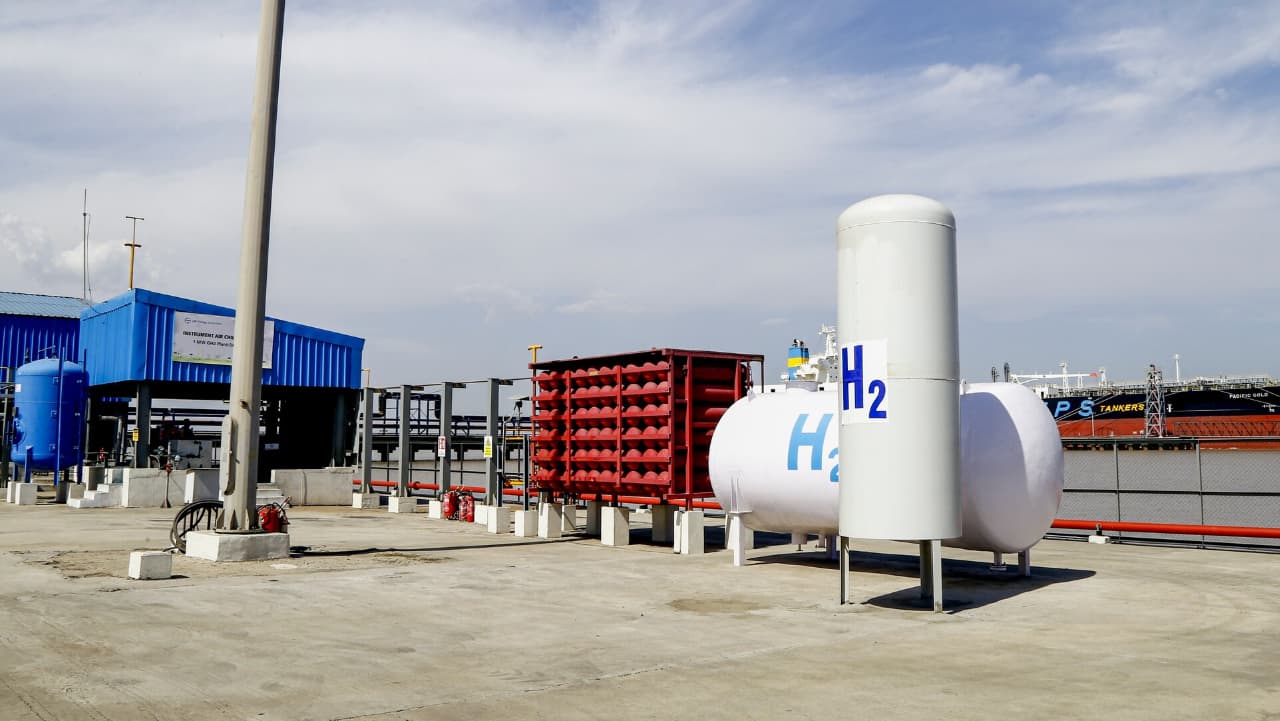
The government plans to evaluate if skilling programmes under the National Green Hydrogen Mission are translating into jobs. Launched in January 2023, the mission aims to create 600,000 jobs. An official said, "The exercise will examine training quality, placement rates and implementation bottlenecks," as the programme faces delays in meeting targets.
The government plans to evaluate if its skilling programmes under the National Green Hydrogen Mission (NGHM) are translating into jobs, better earnings and relevant skills, documents reviewed by Moneycontrol show. The move comes as the mission programme delays in meeting its targets. Launched in January 2023 with an outlay of Rs 19,744 crore, NGHM aims to build green hydrogen production capacity of 5 million tonnes per annum (MTPA) by 2030 and create more than 600,000 jobs, as India builds a workforce for the emerging sector. The production target is now expected to be achieved by 2032, with output projected at around 3 MTPA by 2030, amid uncertainty over export demand and delays in investment decisions. The ministry of new and renewable energy (MNRE) plans to appoint an independent agency to evaluate and monitor skilling, reskilling and upskilling programmes. "The exercise will examine training quality, placement rates and implementation bottlenecks, including whether the skills imparted match industry requirements across the green hydrogen value chain," a government official told Moneycontrol on condition of anonymity. Skilling outcomes were not in line with the projected trajectory, the official added. While an official figure for the number of people who have secured jobs is not yet available, government data shows that 7,885 candidates were trained and 6,957 certified between 2023 and early 2026. Evaluation to cover 14 states over a year The proposed evaluation will cover at least 500 beneficiaries across 14 states and union territories. It will prioritise states with active green hydrogen hubs and pilot projects, including Gujarat, Rajasthan, Andhra Pradesh, Karnataka, Odisha and Tamil Nadu. The study is scheduled to run for 12 months across FY26 and FY27. It will track trainees from enrolment through training and certification to placement, examining employment and income outcomes, wage progression, productivity and safety competencies. It will use baseline and end-line assessments and compare programme beneficiaries with a comparison group. "The evaluation is intended to provide feedback during implementation, identify operational challenges and enable mid-course corrections," a second government official said. As of December 2025, 43 qualification packs defining the skills and competencies required for specific green hydrogen job roles were developed. As many as 78 master trainers and 325 trainers were certified, according to the documents. Another 6,954 candidates were certified under Pradhan Mantri Kaushal Vikas Yojana (PMKVY 4.0), the government's flagship skill development scheme and industry-supported initiatives. Training is being conducted at industry-linked facilities, including BPCL, HPCL and IOCL refineries, as well as institutions associated with Tata Power, Linde-Praxair India and IB Solar. The NGHM is part of a broader efforts to reduce dependence on fossil fuel imports, decarbonise hard-to-abate sectors such as steel, fertilisers and refineries, and position the country as a global hub for green hydrogen production and exports. It is also expected to attract investment, boost domestic manufacturing and support India's target of achieving net-zero emissions by 2070. Green hydrogen is produced by splitting water using electricity generated from renewable energy like solar or wind power and is seen as a clean fuel alternative for industry and a way to curb India's fossil fuel import reliance.