
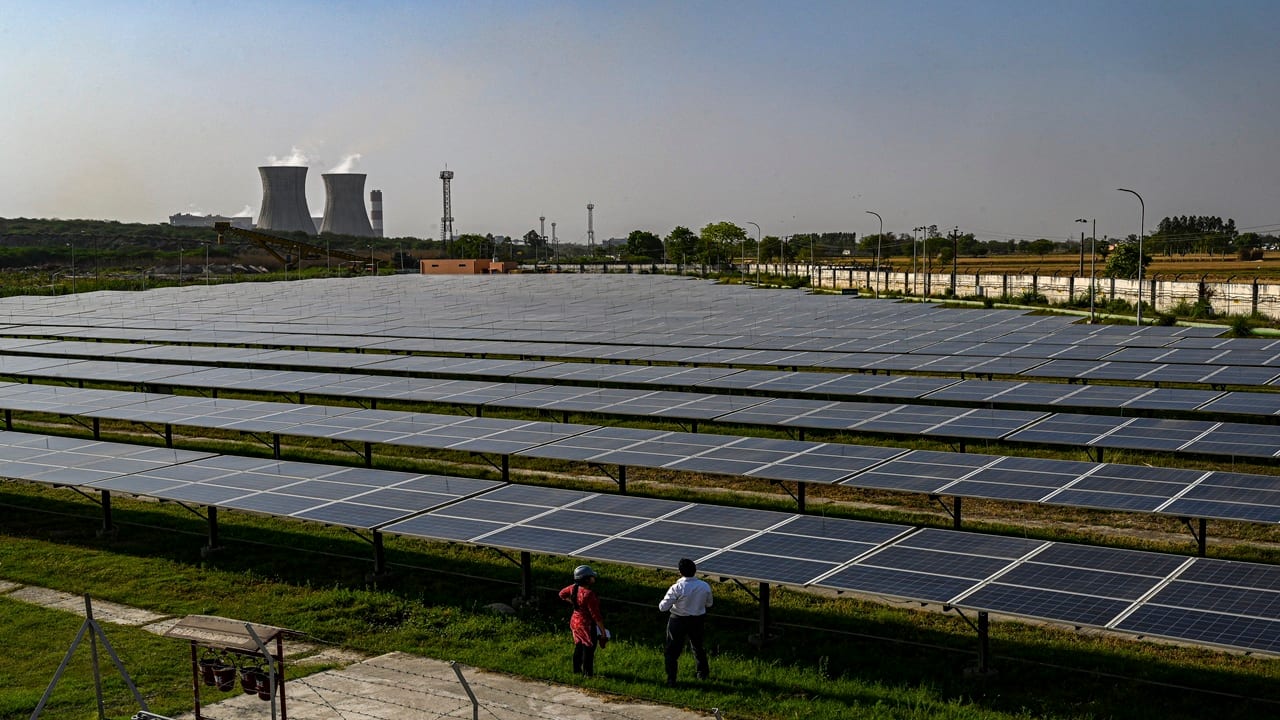
The Union Cabinet on September 30 approved the ₹1,86,405 crore PM DHARA programme to evacuate 135 GW of renewable power. This scheme will build new transmission lines and add 50 GWh of battery storage by FY2032-33. It aims to fix grid bottlenecks and help states manage solar and wind energy variations.
The government's Green Energy Corridor Phase-III (GEC-III) programme has been given a new name — PM DHARA (Developing Harmonized and Accelerated Renewable Energy Access) — as the Union Cabinet on September 30 approved a ₹1,86,405 crore scheme to strengthen the transmission network and facilitate evacuation of up to 135 GW of renewable energy across the country.
The programme will also deploy 50 GWh of battery energy storage systems (BESS) and build new power lines to address the growing challenge of renewable-energy variability, transmission congestion and curtailment. The move comes as renewable-rich states such as Rajasthan and Gujarat face evacuation constraints, with renewable generation in some locations coming up faster than associated transmission infrastructure.
Union Minister Ashwini Vaishnaw, while announcing the Cabinet decision, said the grid needs to be designed differently as the share of renewable energy rises. Solar power is available during the day but not at night, while wind generation varies through the day and across seasons. The grid has to be designed to take the load of these variations, he said.
"The programme will focus on making the grid smarter, upgrading existing infrastructure, building new transmission lines and introducing innovations to manage renewable-energy variability," Vaishnaw said.
Union Minister for New and Renewable Energy Pralhad Joshi said GEC-III will add 51,126 circuit km of transmission lines, 2,28,903 MVA of substation capacity and 50 GWh of battery storage.
The Cabinet-approved programme has an overall outlay of ₹1,86,405 crore, comprising ₹1,36,378 crore for intra-state transmission systems and ₹50,000 crore for 50 GWh of BESS. It will receive ₹54,082 crore in Central Financial Support, according to the Cabinet decision.
The Central support will help offset intra-state transmission charges and is aimed at keeping the cost of renewable power lower. The programme is targeted for completion by FY2032-33.
All greenfield transmission projects under the intra-state transmission component will be implemented through tariff-based competitive bidding (TBCB). Transmission service providers will build, own, operate and maintain these assets under the Build-Own-Operate-Maintain (BOOM) model. Brownfield works involving strengthening and upgrading existing networks will be undertaken on a cost-plus basis.
State Transmission Utilities (STUs) will be the overall implementing agencies for the programme.
Transmission bottleneck
The investment comes as transmission constraints have emerged as a significant bottleneck for India’s rapidly expanding renewable-energy capacity. India curtailed 8,133 GWh of solar power in the second quarter of 2026 to maintain grid security, according to data from the Ministry of New and Renewable Energy (MNRE). The curtailment reflected a mismatch between the commissioning of renewable projects and the readiness of transmission infrastructure.
The issue is particularly important because renewable generation is concentrated in resource-rich regions while demand is spread across the country. When transmission capacity is not available, renewable generators can be forced to back down generation even when power is available.
The 50 GWh BESS component under GEC-III is, therefore, significant. The Cabinet said the storage will help address renewable intermittency, transmission congestion, peak-hour curtailment and demand during non-solar hours. Storage can absorb surplus renewable generation during periods of high output and make power available when solar generation falls.
The programme builds on the government's earlier Green Energy Corridor initiatives. GEC-I and GEC-II were designed to facilitate renewable-energy evacuation through intra-state transmission networks across renewable-rich states.
GEC-III was subsequently proposed to address the much larger transmission requirement arising from India's rapid renewable-energy expansion.