
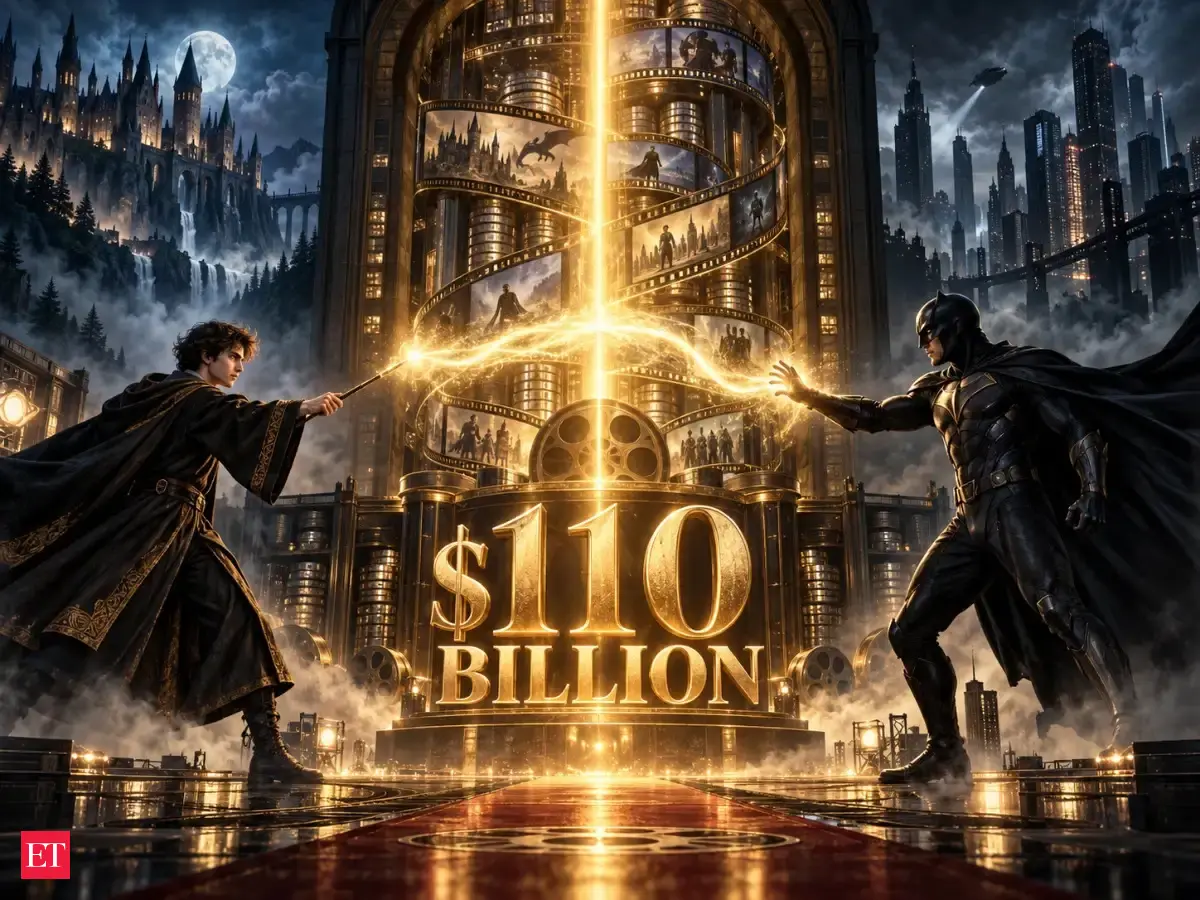
Paramount completed its $110 billion acquisition of Warner Bros Discovery, bringing iconic franchises like Harry Potter, Batman, and Game of Thrones under one roof. This massive deal combines two historic studios and vast entertainment libraries. Reuters described the transaction as a new stage in Hollywood’s tough eat-or-be-eaten economy for viewers.
Synopsis
Paramount's acquisition of Warner Bros Discovery brings some of Hollywood's most valuable franchises under one roof, from Batman, Superman and Harry Potter to Game of Thrones, Friends, Dune, The Lord of the Rings and The Matrix. The $110 billion deal also combines two major studios, streaming platforms and vast entertainment libraries.
Paramount has spent years building a Hollywood identity around franchises such as Mission: Impossible, Top Gun and Transformers.
With its $110 billion acquisition of Warner Bros Discovery now complete, it has inherited something considerably larger: a century-spanning catalogue of characters, studios, stories and brands that have shaped popular culture.
The deal brings together two of Hollywood's historic studios and, in one stroke, places Batman, Superman, Harry Potter, Game of Thrones, Friends, The Lord of the Rings, The Matrix and Looney Tunes under the same corporate roof as Paramount Pictures, CBS, Nickelodeon, MTV and Paramount+.
It is more than a merger of two entertainment businesses. It is the latest chapter in Hollywood's long history of consolidation, in which studios that once competed for audiences have repeatedly absorbed one another, changed hands and been folded into larger media empires.
Live Events
For Paramount, the prize is not simply Warner Bros' current slate. It is the legacy attached to the names it now controls.
From Hollywood's Big Five to four
The shape of Hollywood has been changing for decades.
In 1989, Sony acquired Columbia Pictures and Tri-Star Pictures for $3.4 billion, while Warner Communications acquired Lorimar-Telepictures. Five years later, Viacom bought Paramount for about $10 billion. Time Warner then acquired Turner Broadcasting in 1996, bringing another vast collection of entertainment properties under its umbrella.
The next major shifts came with the creation of NBCUniversal through the 2004 merger of NBC and Vivendi Universal, Disney's $71 billion acquisition of 21st Century Fox in 2019, and Discovery's purchase of WarnerMedia from AT&T in 2022.
Skydance Media's acquisition of Paramount in 2025 was the latest step before the latest, much larger transaction: Paramount Skydance buying Warner Bros Discovery.
The result is striking.
Hollywood's traditional "Big Five" movie studios have effectively become four, with one of the industry's largest studios absorbed by another. Reuters described the transaction as a new stage in Hollywood's "eat-or-be-eaten" economy.
The logic behind the consolidation is straightforward. Traditional studios have been squeezed by streaming, changing cinema habits, the pandemic and rising debt, while the economics of making and distributing entertainment have become increasingly difficult.
Warner Bros Discovery itself emerged from the 2022 WarnerMedia-Discovery merger carrying more than $45 billion in net debt. It ended 2025 with about $29 billion in net debt. The latest deal leaves the combined company with roughly $79 billion in net debt.
That makes the Warner catalogue not merely a collection of famous names, but an enormous library of intellectual property that Paramount can now attempt to monetise across films, television, streaming and licensing.
Batman, Potter and the power of a library
Consider Batman.
Warner Bros' ownership of the DC universe gives Paramount control of one of the most recognisable superhero brands in the world, alongside Superman and the wider DC catalogue. The current DC universe is already expanding across cinema and streaming, giving the new company a pipeline of characters and stories rather than a single franchise.
Then there is Harry Potter.
The film series has already become one of Warner Bros' defining global properties. Its next iteration is being developed as an HBO and HBO Max television series, expected to become one of the major shows of the coming years. Paramount will now own the business behind that television franchise as well.
Game of Thrones offers another kind of asset: a franchise whose original series has ended but whose universe continues to generate new shows. House of the Dragon and A Knight of the Seven Kingdoms demonstrate how a successful intellectual property can keep producing content long after its original story has finished.
The same logic applies to Dune, The Lord of the Rings and The Matrix.
And then there are brands whose value lies in familiarity across generations.
Friends remains one of television's most valuable libraries despite ending decades ago. Looney Tunes, meanwhile, has been part of popular culture since the 1930s.
Paramount is therefore acquiring something difficult to replicate: not just new content, but decades of accumulated audience recognition.
One streaming library, two legacies
The clearest consumer-facing combination may eventually be on the streaming side.
Paramount+ and HBO Max are expected to be folded into a single platform, bringing together Paramount's television and film catalogue with Warner Bros Discovery's enormous library.
That could give viewers a much larger catalogue under one subscription. But the economics are less straightforward.
The merged company is targeting more than $6 billion in annual cost savings while carrying roughly $80 billion in debt, according to Reuters.
That creates pressure to make the enlarged library pay.
The BBC reported that analysts expect streaming prices to rise over time as the combined company seeks profitability. Mike Proulx of Forrester Research told the media house that a combined Paramount+ and HBO Max service would be unlikely to cost less for subscribers who currently use only one of the platforms.
The catalogue, in other words, is both the attraction and the financial engine of the merger.
More movies, but fewer people?
The other immediate question is what happens to Hollywood itself.
The merger comes with commitments designed to address concerns that consolidation could mean fewer films and fewer jobs. Under the settlement with US states, the combined company has agreed to release at least 30 films a year in each of the first two years and 32 annually for the following three years, amounting to 156 films over five years. Most must receive wide theatrical releases, while at least four independent films must be released each year.
There is also a penalty attached to missing the quota: Paramount could ultimately be forced to sell its 49% stake in Miramax.
That commitment matters because consolidation has historically produced mixed results for theatrical cinema.
After Disney bought 21st Century Fox, the number of films released theatrically by 20th Century Fox fell sharply, according to the Reuters analysis. Warner Bros Discovery's own cost-cutting after its 2022 merger also resulted in completed or near-completed films being shelved, including Batgirl, alongside significant layoffs.
The latest deal has already drawn opposition from actors, writers and directors who argue that another round of consolidation could mean fewer productions and jobs.
A CVL Economics report for Los Angeles County estimated that the Paramount-Warner Bros merger could eliminate roughly 4,500 direct film and television jobs and result in $1.26 billion in lost wages over three years.
The settlement includes a workforce fund for retraining displaced workers, but it does not prevent layoffs.
That tension captures the entire deal.
And that may ultimately determine what happens to the legacy Paramount has just inherited.