
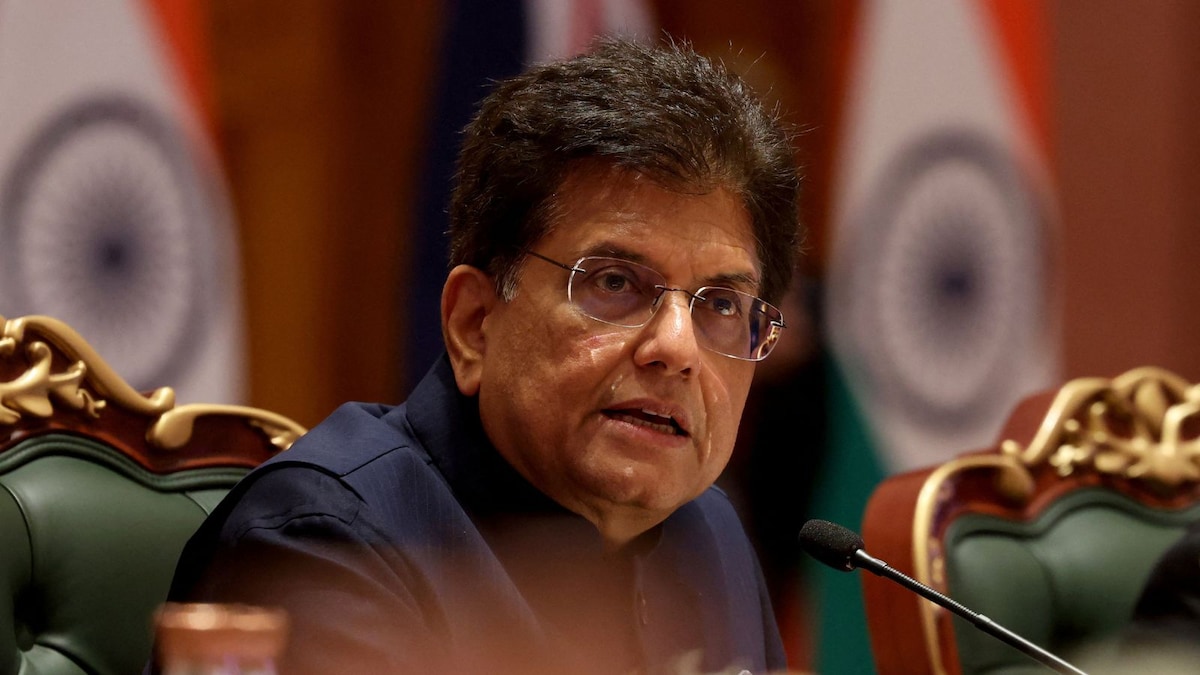
India’s Commerce and Industry Minister, Piyush Goyal, called for a WTO-compliant approach to address global trade distortions at the G20 Trade Ministers’ Meeting in Milwaukee. Goyal said such issues should be addressed through WTO-consistent measures, including anti-dumping and countervailing duties, based on evidence and subject to judicial review by authorities.
India urges WTO-compliant action on dumping, warns against protectionism under supply-chain shift
Stating that India shares the concerns of many G20 members that trade-distorting support in some economies can lead to dumping and predatory pricing, India’s Commerce and Industry Minister, Piyush Goyal said such issues should be addressed through WTO-consistent measures, including anti-dumping and countervailing duties, based on evidence and subject to judicial review.
By Abhimanyu Sharma
(Photo Credit : Reuters )
India’s Commerce and Industry Minister, Piyush Goyal, called for a WTO-compliant approach to address global trade distortions on the concluding day of the G20 Trade Ministers’ Meeting in Milwaukee, United States.
Stating that India shares the concerns of many G20 members that trade-distorting support in some economies can lead to dumping and predatory pricing, Goyal said such issues should be addressed through WTO-consistent measures, including anti-dumping and countervailing duties, based on evidence and subject to judicial review.
He emphasised that industrial capacity in itself is not the problem, but that distortions can arise when the geographical concentration of production is driven by hidden subsidies and state support.
Describing diversification of production and supply chains as a legitimate objective, he said it should not be used as a pretext for measures that fall outside WTO rules or to shift the burden of adjustment onto developing countries that require policy space to industrialise. He also said that the sharing of statistics and data should take place through existing mechanisms.
On proposals to update the Most-Favoured-Nation (MFN) principle, Goyal said India’s trade with G20 members depends on a transparent, non-discriminatory and rules-based trading system. He said MFN treatment is a key pillar of this framework, ensuring that the same terms apply to both the smallest and the largest traders.
He stressed that consensus remains central to the WTO and said special and differential treatment must be preserved to enable developing countries to catch up with advanced economies. He also called for the restoration of the WTO’s two-tier dispute settlement system.
Reaffirming India’s commitment to a rules-based, fair, equitable, non-discriminatory, transparent, open, inclusive and multilateral trading system with the WTO at its core, Goyal underscored the importance of preserving policy space for developing countries to grow their economies and ensure food security, while upholding consensus-based decision-making. He also extended India’s full support to the United Kingdom for its G20 Presidency in 2027.
On the sidelines of the meeting, Goyal held bilateral meetings with the Minister for Trade and Tourism of Australia, the Minister of Commerce of Saudi Arabia, the Minister Delegate for Foreign Trade and Economic Attractiveness of France, the Minister for Trade of the Republic of Korea and the Minister of International Trade of Canada.