
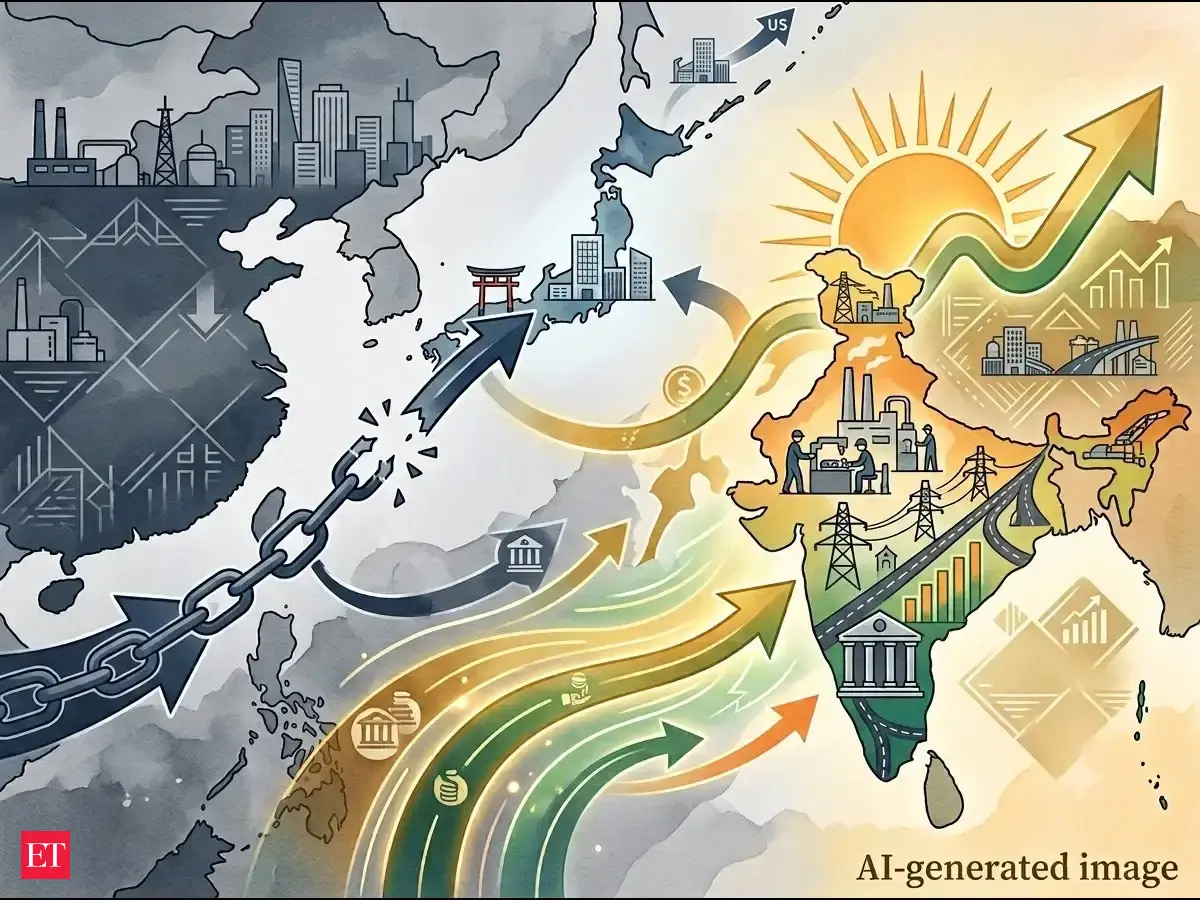
Japanese companies are leaving China at a record pace, with the number of firms falling to 10,118 in June 2026. Rising costs and geopolitical tensions pushed many to look elsewhere. India is now a top choice for these businesses, as its large market offers new opportunities for manufacturing and investment.
Synopsis
Japanese companies are reducing their presence in China due to rising competition and geopolitical tensions. They are now considering investment opportunities in India, which offers a large domestic market. Japanese financial institutions are also expanding their operations in India and viewing it as a promising destination. While Japan is diversifying its investments, it is still maintaining significant ties with China.
Japanese companies are pulling back from China at a pace not seen in years. The shift is being driven by more than weak Chinese demand. Geopolitical tensions, tougher operating conditions, rising costs and increasingly formidable Chinese competitors are changing the calculation for Japan Inc.
The US is trying to court the Japanese through an aggressive reindustrialisation push, while Southeast Asia is already attracting supply-chain diversification. India, meanwhile, is emerging as a different kind of beneficiary with a large domestic market that can support manufacturing, exports and financial investment at the same time.
Why Japan Inc is losing its appetite for China
The scale of the retreat of Japanese companies from China is striking. According to a survey by Japanese corporate research firm Teikoku Databank, the number of Japanese companies with a presence in China fell to 10,118 in June 2026, the lowest level since the survey began in 2010. That is down 22% in just two years and almost 30% from the peak of 14,394 companies recorded in 2012.
Live Events
The latest numbers also show that this is not simply a case of a few companies closing unprofitable factories. Between 2024 and 2026, 4,137 Japanese companies withdrew from China or could no longer be accounted for, while only 1,221 new entrants appeared. The latter was the lowest number outside the pandemic period.
More than 40% of Japanese companies still operating in China are manufacturers, making the retreat particularly significant for supply chains. China had long offered Japanese manufacturers an unusual combination of scale, relatively low costs, a deep supplier ecosystem and access to a huge consumer market.
Teikoku Databank identified China's property downturn, restrictions on rare-earth exports, overcapacity and competition from Chinese companies backed by the state among the pressures facing Japanese businesses. The deterioration in bilateral relations has added another layer of risk.
Geopolitics is creating strategic risk
The deterioration in Japan-China relations has made an existing corporate reassessment more urgent. Japanese firms had already been planning to reduce their China exposure but were now considering withdrawal with greater urgency as relations deteriorated. The problem is not simply the possibility of tariffs or weaker sales. Japanese companies increasingly have to consider whether their employees, technology and supply chains could become exposed to political disputes.
That concern has become more tangible this year. China has tightened scrutiny of Japanese companies and added Japanese entities to export-control and watch lists. Japanese nationals have also been detained in cases involving alleged violations of rules governing dual-use goods. "Japanese firms and their employees increasingly feel unwelcome and unsafe in China," Jeremy Chan, an analyst at political consultancy firm Eurasia Group, told CNBC.
Katsuya Yamamoto, director of the strategy and deterrence programme at the Sasakawa Peace Foundation in Tokyo, struck a more measured note. Talking to the South China Morning Post, he said, China will remain one of the world's largest and most attractive markets. But unless Beijing improves the business environment for foreign companies and helps stabilise bilateral relations, Japanese firms are unlikely to expand in China as they did in the past.
To be sure, this is not a wholesale Japan-China economic divorce. China remains too large and too deeply integrated into Japanese supply chains to be abandoned overnight. The change is that China is losing its position as the automatic destination for the next factory, the next investment or the next expansion project.
Chinese competition is becoming a problem
For Japanese manufacturers, the China problem is also increasingly commercial. Automakers are a clear example. Japanese carmakers once benefited from China's rapidly expanding vehicle market. They now face aggressive Chinese electric vehicle manufacturers with strong domestic supply chains and increasingly competitive technology.
Kei Koga, a professor at Singapore's Nanyang Technological University, told CNBC that automakers, parts suppliers and export-oriented manufacturers are likely to be among the companies most likely to scale back. Companies that have deeply localised their operations and can compete successfully with Chinese rivals, particularly in areas such as medical and precision equipment, have stronger reasons to remain.
The result is a more selective China strategy. Japanese companies are not necessarily shutting every Chinese plant but deciding which operations justify the risk and capital.
The US wants the investment too
The retreat from China does not automatically mean India gets every Japanese factory. The US is competing aggressively for Japanese capital. Jesper Koll of Monex Group told CNBC that the share of profits of companies listed on the Tokyo Stock Price Index (TOPIX) coming from China had fallen below 15% this year from 23% in 2020. The US share had moved in the opposite direction, reaching 35% from 25%. Koll told CNBC that Washington is "openly courting" Japanese companies as part of its reindustrialisation push, while Beijing is increasingly pursuing a "made in and made by China" model.
That courtship has a substantial financial component. Under the 2025 US-Japan tariff agreement, Japan committed up to $550 billion in loans, investments and guarantees for projects in the US, with sectors including semiconductors, steel, critical minerals and AI among the priorities.
Japanese companies appear to be spreading risk across the US, India, Southeast Asia and Japan itself.
Why India is becoming part of the answer
India's opportunity lies in being able to offer a large domestic market alongside a growing manufacturing base, something Vietnam or other Southeast Asian economies cannot offer at the same scale. This is increasingly influencing Japanese financial institutions as well as manufacturers.
A report in Nikkei Asia a few months ago revealed that Japanese regional banks had reduced their branch presence in China by about 20% over five years, while lending by Japan's three megabanks, MUFG, SMBC and Mizuho, had fallen by as much as 40%.
The banks are following their customers. Japanese regional lenders have been building operations in Singapore and Southeast Asia, while the megabanks have been making much larger bets directly on India.
Japanese capital is moving beyond manufacturing
The most important part is that Japanese interest in India is no longer confined to factories. SMBC acquired a 20% stake in YES Bank for about $1.6 billion. MUFG acquired 20% of Shriram Finance in a transaction worth roughly $4.45 billion and has expanded its investment in DMI Finance. Mizuho's securities arm acquired a majority stake in investment bank Avendus. These deals indicate that Japanese institutions are positioning themselves inside India's financial system rather than merely opening branches to serve Japanese expatriate companies.
Mizuho CEO Masahiko Kato told ET a few months ago that India had rapidly become the most promising destination for Japanese companies. His bank's objective is to build an India-Japan investment corridor linking Japanese companies, Indian businesses and international capital.
The Japanese footprint in India is already substantial. Japanese FDI in India has crossed Rs 2.7 lakh crore, with about 1,400 Japanese companies operating in the country.
Manufacturing could deepen the shift
The automotive sector shows what this could look like on the ground. Toyota, Honda and Suzuki have been expanding Indian production as they reduce their dependence on China. Toyota and Suzuki together had pledged around $11 billion for expansion in India, while Suzuki planned to raise production capacity substantially and use India increasingly as an export base.
Suzuki's longer-term plans are particularly revealing. Reuters reported in 2025 that the company expected India to account for 60% of its global sales and planned investment by 2030. India is already its largest market and is being developed as an export base for Africa and the Middle East.
This is where India's opportunity differs from simply attracting relocated Chinese production. Japanese companies can build plants in India not only to replace China-based production but to serve India's own expanding market and then export from the country.
India cannot assume that Japanese companies leaving China will automatically come here. Vietnam, Indonesia, Thailand, Japan itself and the US are competing for the same investment. India also has weaknesses that could constrain the opportunity. It still faces shortages of skilled labour, insufficient R&D capacity and heavy dependence on Chinese intermediate goods in some sectors.
The larger shift is less dramatic than a sudden Japanese exodus from China, but more consequential in the long run. China is losing its old role as Japan's default expansion market. The US is pulling investment through industrial policy and market access while Southeast Asia is absorbing supply-chain diversification.
India's advantage is that it can offer Japanese companies something broader -- a manufacturing base, a huge consumer market and a financial-growth story in one country. The Japanese pivot is still at an early stage, but the movement of factories, banks and capital in the same direction suggests that India's role in Japan Inc's Asia strategy is becoming structural rather than opportunistic.
(You can now subscribe to our Economic Times WhatsApp channel)
Q2 earnings season: Will it settle or add to confusion in the stock market?
How Sebi busted Growpital’s ‘assured’ returns, LLPs and money trail
The biggest assumption: From $600 billion to $2 trillion
A for apple, Y for yak and, for the first time, a price next to it. Will this change the non-agri part of the rural economy?