
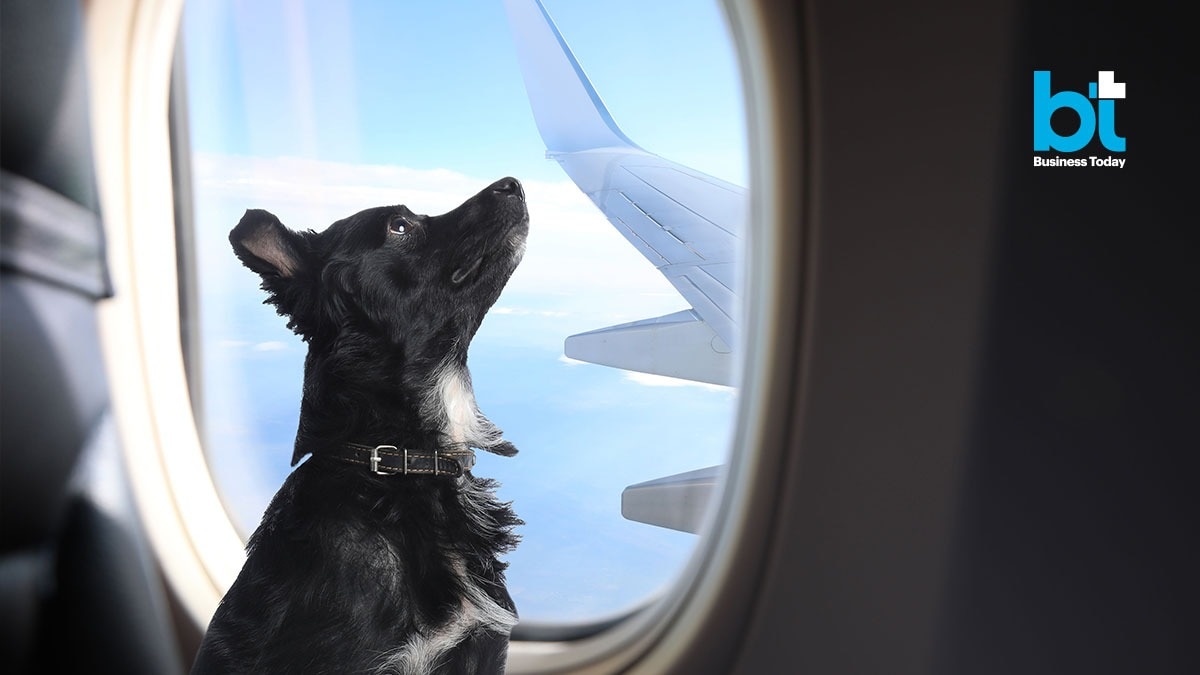
More people now take pets on holidays instead of using boarding kennels. Air India and Akasa Air allow cats and dogs on flights. Sanjana Kapoor said, “Pets are no longer necessarily left behind with a neighbour.” You must check specific airline rules and destination regulations before you book your travel.
“Pets are no longer necessarily left behind with a neighbour or at a boarding kennel. They are increasingly coming along for the holiday and, of course, the relocation,” says New Delhi-based Sanjana Kapoor, who flies frequently with her Shih Tzu, Coco. Of course, she says, it’s because her pet is small enough to fit in the cabin that she prefers to take him along rather than leave him in a boarding. “If my dog was larger, maybe I wouldn’t want to put him in the hold of an aircraft on vacation; in that case, I would have left him at a kennel,” she adds.
Among major airlines, Air India and Akasa Air are the two practical options for passengers who want a structured service for travelling with their pets. But here, too, it’s only dogs and cats. You cannot fly with your pet rabbits, for instance. IndiGo does not permit regular pets on its aircraft and makes an exception for guide dogs accompanying blind passengers.
Air India’s revamped Paws on Board programme allows domesticated cats and dogs weighing up to 10 kg, including the carrier, in Economy class. The pet must stay inside a soft-sided, leak-proof, ventilated carrier no larger than 17x10x9 inches, placed beneath the seat. Cabin pets must be at least eight weeks old, and bookings should be made at least 48 hours before departure. Pets are seated with their humans in aisle seats in the last five rows. Pregnant, sedated, critically ill or medically unfit animals are not accepted.
The domestic price is Rs 7,500 for a pet in the cabin. Between 10 kg and 32 kg, including the crate, the animal travels as checked baggage in an IATA-compliant hard kennel for Rs 16,000. Above 32 kg, the booking moves to cargo.
Snub-nosed breeds, including Shih Tzus and pugs, are not accepted in the hold because of their greater respiratory risk. So, they can travel on Air India only if they qualify for the cabin.
Internationally, Air India’s in-cabin charges generally start at $140, with some sectors priced higher, while checked-baggage pets cost $350. Destination rules matter as much as airline rules, and travellers need to check both the carrier’s policy and the entry regulations of the destination country. For instance, the UK does not allow pets in cabin, which becomes a particular problem if you have a snub-nosed dog as the carrier does not fly it in the hold!
Akasa’s rules are similar. Cats and dogs must be at least three months old. Up to 10 kg, including the carrier, they may travel in the cabin; heavier animals can travel in the hold. Akasa permits up to three pets on a flight and offers pet travellers priority check-in, priority boarding, and a pre-booked window seat. Published fares are Rs 7,500 for in-cabin travel and about Rs 15,000 for a pet travelling in the hold.
Around 60% of Akasa’s pet passengers have been dogs and the rest cats, while the Bengaluru-Delhi-Bengaluru sector accounts for 13.66% of its pet traffic.
The Amadeus Travel Trends Report 2026 refers to it as the “Pawprint Economy”, pointing to forecasts that the global pet industry could be worth $500 billion by 2030. Hotels have been quicker to respond: pet-friendly resorts, restaurants, cafés, and even co-working spaces are increasingly commonplace. Aviation is catching up.
Bangkok-based Divya Dugar is a pet parent who has spent years travelling with her three dogs across India by rail and road. She chronicled these experiences in her book Chaos in a Coupe. Four years ago, she flew them from Delhi to Paris; and then recently, she travelled with them from Paris to Bangkok.
Her first rule is to begin with the country, not the airline. “Each country has different rules of importing and exporting a dog,” she says. Rabies requirements, booster vaccinations, and other documentation can take considerable time. Only once those are in place should travellers begin deciding which airline and route to use.
Dugar recommends using a pet-relocation agency such as PetFly selectively. “Outsource the complicated documentation and airport handling, but not necessarily the entire move.”
Such agencies can also accompany an animal through parts of the airport inaccessible to its owner and remain with it until it is handed over for the flight.
She favours direct flights whenever possible, choosing Air France for Delhi-Paris for precisely that reason. For an India to the US journey, she recommends Lufthansa via Munich because of the pet-care facilities available during the connection.
Meanwhile, at the luxury end, a new class of pet-first aviation has emerged overseas. Most are public or private charter operators rather than conventional scheduled airlines.
BARK Air was created around the idea of offering dog-first charter flights. It sells a dog-and-human ticket on routes such as New York-San Francisco for around $7,450 and New York-London for roughly $9,900 on selected 2026 flights. K9 Jets, similarly, operates shared private-jet flights for people travelling with animals, including long-haul international sectors. Other operators, including RetrievAir in the US and SingaPaw Air in Asia, have entered the same niche market.
Looks like the ‘paw’fect vacation is one where your pooch accompanies you, and airlines are finally coming to your rescue.