
S&P Global said India’s economy is set to grow 7% in FY27. While the country saw 7.7% growth in 2025-26, experts now look beyond that headline. They said sustaining this pace depends on reforms and private investment. India has strong buffers, but the nation needs more capital to keep growing.
Synopsis
India’s economy is set to grow 7% in FY27, according to S&P Global, which sees domestic demand, private investment, manufacturing, trade, energy security, renewable power, digital infrastructure and technology shaping India’s next phase of economic growth.
India’s economy has delivered the number that grabs attention: 7.7% growth in 2025-26, followed by 7.8% in the first quarter of 2026-27.
But S&P Global and Crisil’s latest India research is looking beyond that headline. S&P is reiterating its outlook for India to grow around 7% in 2026-27, with growth moderating from the previous year even as domestic demand and public investment provide support.
The bigger question in 'India Forward: Reimagining Growth,' is what India needs to build underneath that growth rate to sustain it.
The research argues that India enters this phase with formidable macroeconomic buffers, but also with a different set of vulnerabilities. The economy is becoming more exposed to global capital, energy markets and supply chains even as its domestic foundations remain relatively strong.
Live Events
For S&P Global economists Dharmakirti Joshi and Hanna Luchnikava-Schorsch, the 7.7% expansion in 2025-26 demonstrates the resilience of domestic growth drivers despite high US tariffs and geopolitical uncertainty. Their 7% growth outlook for 2026-27 remains in place, but they argue that sustaining that pace will increasingly depend on reforms, investment and deeper integration with global trade.
That sets up the central question running through the research: what will power India’s next leg of growth?
Growth needs a new investment push
India begins with a strong cushion.
Foreign exchange reserves cover more than nine months of imports, banks’ gross non-performing assets are at a decade-low 1.8%, and foodgrain stocks stood at 92.6 million tonnes in July, more than twice prescribed buffer norms.
But S&P’s researchers see a more complicated picture once the focus shifts from buffers to capital formation.
Net foreign portfolio inflows fell 16.6% in 2025-26. Gross FDI remained healthy at $94.5 billion, but net FDI was only $7.8 billion after accounting for repatriation by foreign investors and outward investment by Indian companies.
India is increasingly both a capital importer and exporter.
That matters because sustaining high growth requires more investment.
The investment rate is around 32% of GDP, while the World Bank estimates that annual growth of 7.8% would be required to meet the Viksit Bharat 2047 objective.
S&P’s message is that public investment can continue to build the platform, but private investment needs to take the lead.
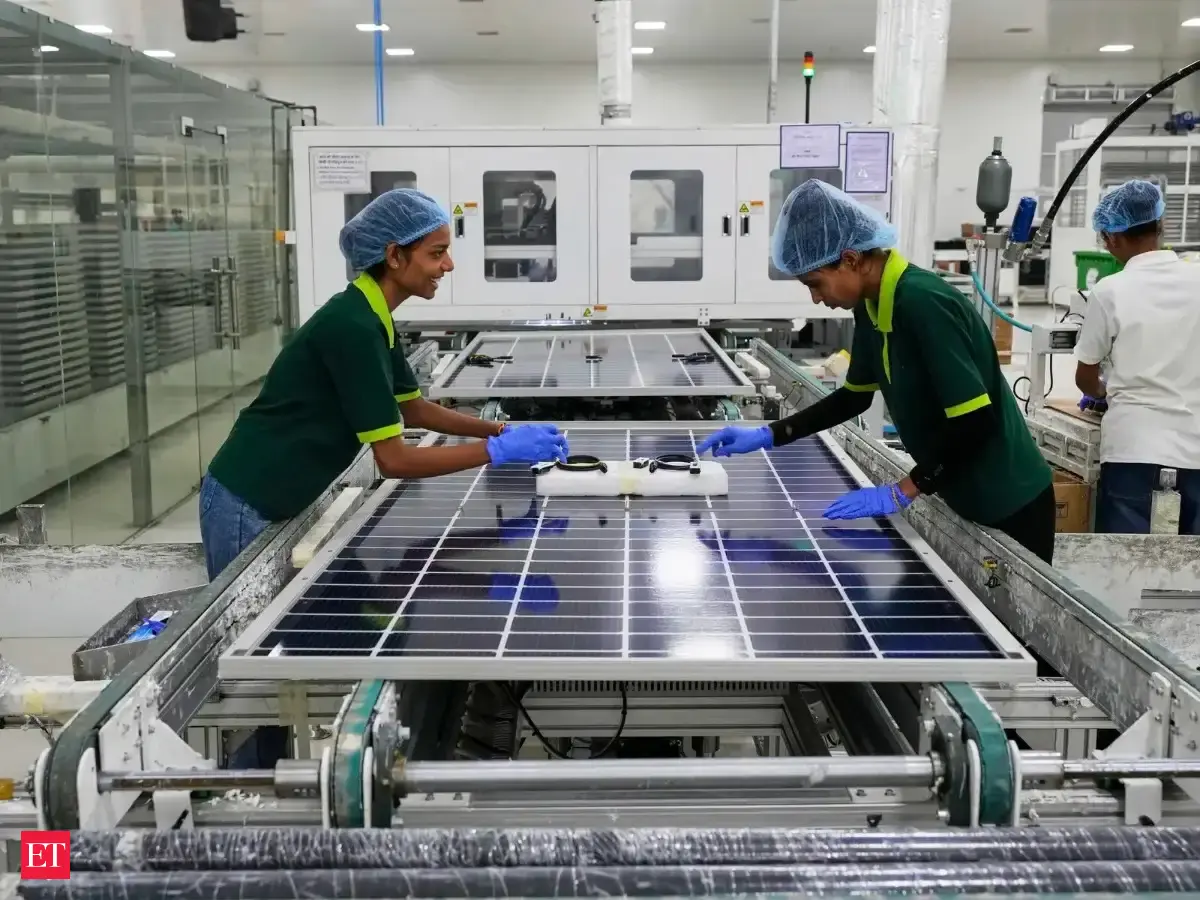
Crisil estimates that emerging sectors such as defence, data centres, solar photovoltaics, batteries, semiconductors and electronics, and electric vehicles could account for 25-27% of industrial investment over the next five years, compared with 12% in the previous five.
The challenge, therefore, is not simply to attract capital. It is to convert that capital into the productive capacity that can support the next economic cycle.
The capital India needs to capture
S&P researchers see India’s recent free-trade agreements as more than vehicles for market access. They can also help attract investment and embed India more deeply in global supply chains.
Six trade deals signed over the past four years, with an EU agreement expected later in 2026, would give India FTAs covering more than half of the world’s top importing economies.
The logic is straightforward: trade access can pull investment in, while investment can build export capacity.
The next growth wave will need more power
S&P Global researchers Ashish Singla, Mohd. Sahil Ali and Jessica Jin see a structural shift underway in India’s power system.
Electricity demand is expected to grow 5.56% annually between 2025 and 2035, more than twice the 2.47% growth expected in total energy demand. Electricity’s share of India’s energy basket could rise to nearly 25% by 2035 from about 19% in 2025.
Some of the fastest-growing sources of demand are also sectors India wants to build: data centres, green hydrogen, electric mobility and increasingly electrified industry.
The combined electricity demand of data centres and green hydrogen could rise nearly ninefold to around 240 terawatt-hours by 2035.
That changes the power challenge. It is no longer simply about adding generation capacity, but about whether the grid can absorb and deliver that power reliably.
More than 6 terawatt-hours of solar generation was stranded between April and June 2026 because of transmission constraints. Renewable curtailment was around 3,300 GWh in the first six months of 2026, with solar accounting for more than 85%.
S&P Global Energy estimates that only about 10% of curtailment was explained by transmission bottlenecks, with the bulk linked to grid-security concerns and system inflexibility.
India has therefore moved from asking how much renewable capacity it can build to asking how much clean power the system can reliably absorb.
S&P expects India to add about 300 GW of solar photovoltaic capacity and roughly 95 GW of storage between 2026 and 2035.
But that expansion creates another challenge: reducing dependence on imported fossil fuels should not simply replace it with dependence on imported solar cells, wafers, batteries, power electronics and critical minerals.
The clean-energy transition is consequently becoming a manufacturing story too.
S&P estimates that localising clean-technology supply chains could require $40-50 billion of investment by 2035.
Ethanol shows how energy security meets the real economy
The E20 programme fits into this wider energy-security story.
For Swati Mathur and Abhay Pratap Singh, ethanol is no longer simply a blending target. It is becoming part of India’s broader strategy to reduce its exposure to imported crude.
Since ethanol supply year 2014-15, the programme has generated $22 billion in farmer income and more than $25 billion in foreign-exchange savings.
But scaling it further creates new trade-offs.
Grain-based ethanol has overtaken molasses-based production, increasing pressure on corn supplies for animal feed, while India’s maize yields remain below global averages.
Consumer adoption presents another test.
Mathur and Singh argue that long-term adoption will depend on vehicle readiness, fuelling infrastructure, transparent economics and consumer confidence.
“Achieving higher ethanol adoption through E20, E85 or E100 will require more than policy intent,” they write.
The infrastructure story moves into the digital economy
The same question of capacity appears in India’s digital economy.
Data-centre capacity is around 1.5 GW and is expected to reach 26.3 GW by 2031-32. But that expansion requires power, land, connectivity and regulatory infrastructure.
S&P’s analysis of state policies shows how competition between states to attract data-centre investment is itself becoming part of India’s infrastructure build-out.
The stakes extend beyond data centres.
India is seeking to build the physical and digital infrastructure needed to capture new global investment in AI, cloud computing and other strategic technologies.
The final layer is financial infrastructure
The research eventually moves from physical infrastructure to the infrastructure of money itself.
Geeta Chugh and Zahabia Gupta argue that the digital rupee should not be judged simply by whether it can replicate the retail success of UPI.
Its larger opportunity, they say, lies in programmability and settlement.
The digital rupee could become a “fourth layer” of India’s digital public infrastructure alongside Aadhaar, UPI and account aggregators, allowing conditions on how and where money can be used to be embedded directly into transactions.
Potential applications include agricultural lending, subsidies, carbon credits, government securities and cross-border payments.
The thread running through the research is becoming clear: India’s next phase is not just about scaling what already exists. It is about building systems that allow the economy to absorb a much larger scale of activity.
The next chapter is about capacity
S&P’s 7% growth outlook for 2026-27 is therefore less a story about whether India can produce another strong headline number and more about what it needs to do to sustain that trajectory. The forecast remains in place even as the external environment becomes more difficult.
The research takes the reader from India’s macroeconomic buffers to the investment needed to build productive capacity, then into the energy and power systems required to support that investment. From there, the story runs through manufacturing, trade, clean technology, ethanol, data centres and finally digital finance.
The common thread is capacity.
India needs to turn macroeconomic resilience into productive investment, foreign capital into manufacturing and infrastructure, energy vulnerability into greater supply security, and renewable capacity into reliable electricity.
It also needs deeper supply chains and stronger private capital formation while becoming more integrated with global markets.
That is why S&P’s growth story stretches well beyond GDP.
The next chapter of India’s growth is about what sits underneath the number -- capital, power, technology, energy, trade and the infrastructure needed to make them work together.
(You can now subscribe to our Economic Times WhatsApp channel)
Gold paradox: Why India, a refining giant, is not a big bullion exporter
A refinery is not a laptop: Why America's diesel problem can't be switched off
How Irdai’s big reset can change insurance landscape, customer choice
Everyone asks who will fund AI. Few ask who pays if it burns
Can Fly91’s flightpath for India’s smallest airline defy the doomy past?
Smugglonomics: Geckos, dry dates, human hair – what makes something worth smuggling?