
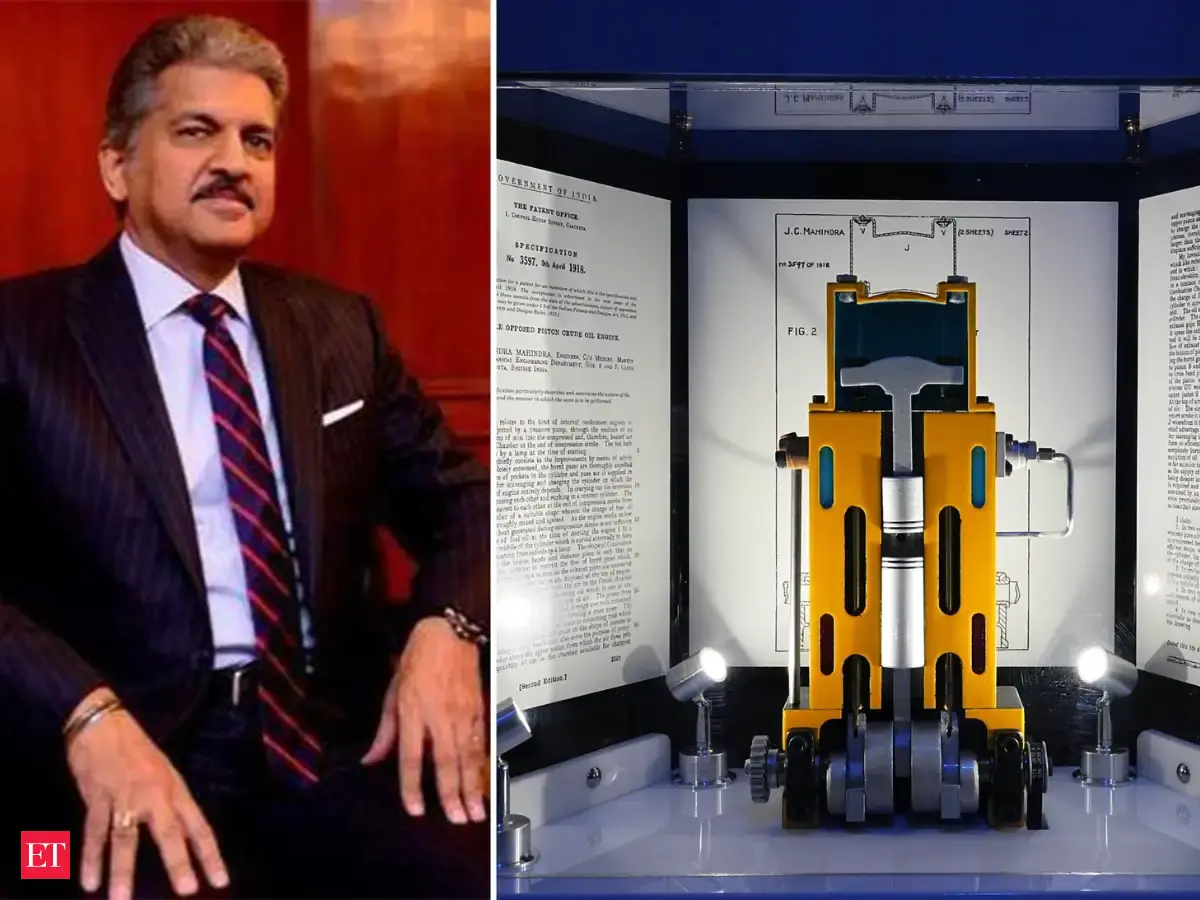
Anand Mahindra shared a video of a 108-year-old engine patented by his grandfather, J.C. Mahindra. The Mahindra Research Valley team built the prototype after Vaidehi Mayekar found the patent in company archives. They unveiled and started the working engine on Founders’ Day, bringing the old design to life again.
Synopsis
Anand Mahindra announced the successful creation of an engine patented by his grandfather J.C. Mahindra 108 years ago. The engine prototype was unveiled and started on Founders’ Day, six months after the patent's discovery. This discovery was made by Vaidehi Mayekar while organizing the company's archives and emphasized the company's engineering roots. The Mahindra Research Valley team interpreted the patent and created a working version of the engine.
Anand Mahindra the Chairman of Mahindra & Mahindra group posted on social media of his company's team successfull attempt to build an engine that was patented by his grandfather J.C Mahindra 108 years ago. The prototype was unveiled and fired up on Founders’ Day, six months after the discovery of the patent was shared publicly.
The project began after the 1918 patent, filed by J.C. Mahindra for an internal combustion engine designed to run on crude oil, came to light while the company was organising its archives.
The patent had been discovered by Vaidehi Mayekar, a senior manager involved in organising the company’s archives. She found the document while going through boxes of files and memorabilia in the lead-up to World Intellectual Property Day. The discovery revealed that J.C. Mahindra had secured a patent related to internal combustion engine technology, a detail that had not been widely known within the family or the Group.
Live Events
Six months ago, the story of the patent was shared with the expectation that it would end with the discovery. Instead, the team at Mahindra Research Valley in Chennai decided to study the 108-year-old document, interpret its technical drawings and construct a working version of the engine.
The team eventually unveiled the prototype on Founders’ Day and started the engine, turning a century-old patent document into a functioning piece of engineering.
J.C. Mahindra’s engineering background and patent
J.C. Mahindra had trained as an engineer at Veermata Jijabai Technological Institute in Mumbai before pursuing much of his career in the steel industry, including a stint at Tata Steel.
During World War II, he served as India’s first Iron and Steel Controller, a role in which he developed relationships with steel mills around the world. Those connections later proved useful when he and his brother, K.C. Mahindra, established a trading business.
The business subsequently evolved into manufacturing, including the introduction of Willys Jeeps and International Harvester tractors to India.
Within the family, J.C. Mahindra had occasionally been described by his son and nephew as a “tinkerer”. However, the existence of his patent had remained a relatively obscure part of the family’s history.
The lack of awareness was attributed in part to the fact that the Group’s archives and memorabilia had not been systematically organised for decades.
From archival discovery to working prototype
The discovery of the patent highlighted a previously overlooked connection between J.C. Mahindra’s engineering interests and the later development of a business closely associated with automobiles and engineering.
The patent itself may not have been considered a seminal development in engine technology, but its rediscovery provided an insight into an early chapter of J.C. Mahindra’s work as an engineer and inventor.
After examining the patent, the Mahindra Research Valley team undertook the task of interpreting the original drawings and recreating the engine. The resulting prototype was presented and started during Founders’ Day celebrations.
A message for Mahindra engineers and innovators
The recreation of the engine was described not merely as an exercise in nostalgia but as a reminder of the importance of experimentation and innovation.
The revival of J.C. Mahindra’s design was also seen as an opportunity to connect the Group’s current engineering community with an aspect of its early history that had largely remained outside its institutional memory.
The project was described as a tribute to the founders and their approach to engineering, with the hope that J.C. Mahindra’s example as a “tinkerer” would encourage engineers across the Mahindra Group to continue imagining, experimenting and building.
The discovery of the patent had itself been linked to World Intellectual Property Day, when the document was brought to attention during the Group’s archival work. Its eventual transformation into a working prototype has now added a new chapter to the story of J.C. Mahindra’s 1918 invention.
(You can now subscribe to our Economic Times WhatsApp channel)
Airlines Q2 turbulence: Fewer passengers, rising fares and a crude shock
The NBFC saga - Part 1: How RBI moved from protecting depositors to policing systemic risk