
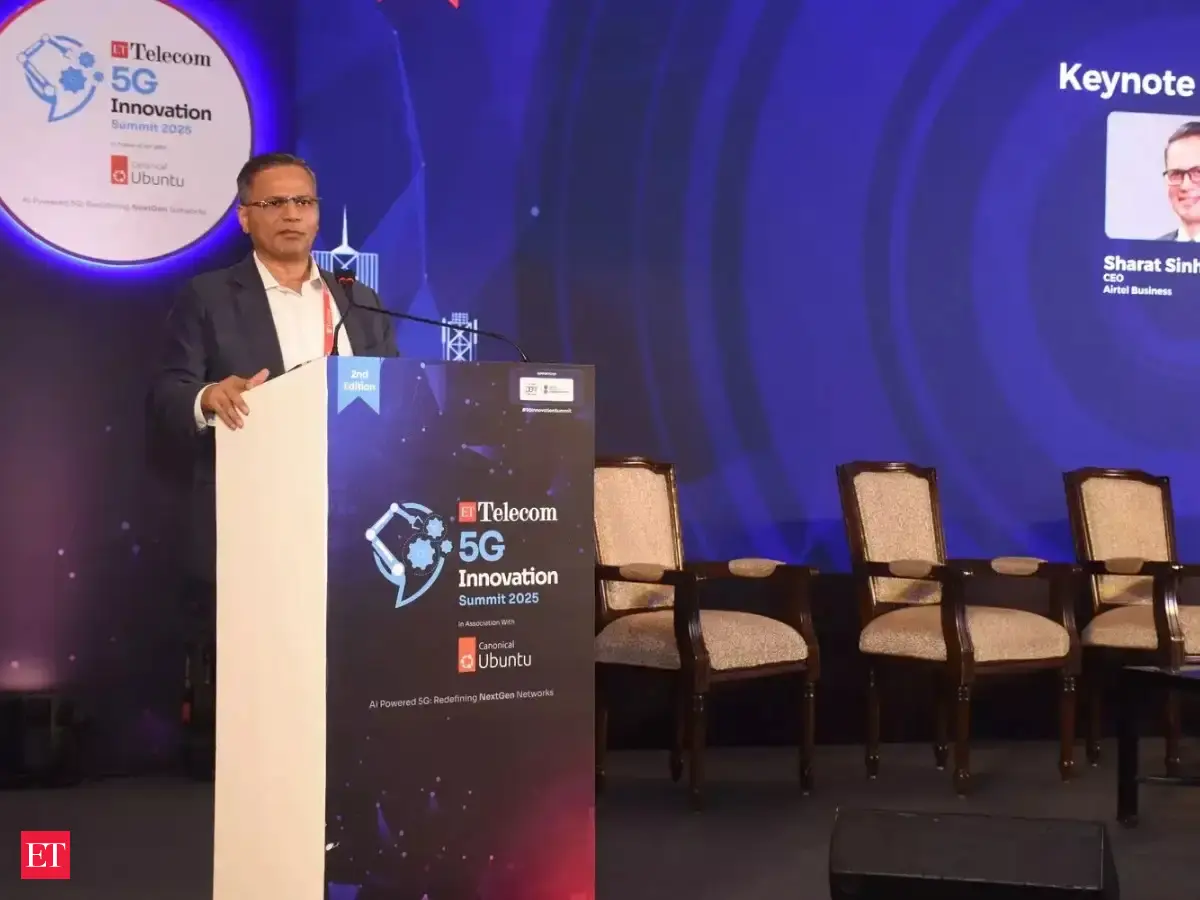
Airtel Business CEO Sharat Sinha said guardrails will help unlock productivity gains from AI. He called the government’s plan for new AI regulations a step in the right direction. Airtel aims to deliver safe experiences for customers while working closely with regulators to ensure all their practices remain fully compliant.
Synopsis
Sharat Sinha highlighted the ongoing evolution of AI architecture and methodologies for safe deployment. The government's upcoming consultation paper on AI regulations aims to address issues like safety and deepfakes. Airtel is committed to compliant practices that enhance productivity through AI. Sinha emphasized the growth of cybersecurity services in response to emerging digital threats. The company aims to deliver safe experiences for both enterprise and consumer segments.
New Delhi: The architecture and methodologies for safely deploying Artificial Intelligence will continue to evolve, as was the case with previous technologies, and adequate guardrails will pave the way to unlock strong productivity gains from AI, Airtel Business CEO Sharat Sinha said.
On the government's plan to soon release a consultation paper on AI regulation dealing with issues like tech safety, deepfakes and a human-first approach, Sinha said it was "a step in the right direction".
"We work very closely with both government regulators, as well as our customers, to make sure that whatever we do is compliant, and we play a positive role in bringing out such specifications. So, that will continue to be our effort," he told PTI.
Sinha said the company would like to see regulation that enables infrastructure to drive right business outcomes, "so that people can safely deploy AI, and also leverage AI to create more productivity in the country".
Live Events
Airtel, he added, "will be playing a positive and active role in that".
Last week, IT Minister Ashwini Vaishnaw said the government, in a month's time, will bring a consultation paper on AI regulations, which will focus on key aspects such as AI safety, deepfakes and a human-first approach.
The consultation paper will form the base for AI regulations, Vaishnaw had said, adding that the time has come for India to have such a framework.
On the global debate surrounding AI, the Airtel Business CEO noted that as is the case with any technology, even for artificial intelligence, having tools or AI agents with the right guardrails and building an enterprise architecture that enables their safe deployment will ensure productivity gains.
"It is like any technology. If you deploy artificial intelligence or AI agents with the right guardrails, and if your enterprise architecture is built so that they can be safely deployed, you can get all the essential productivity gains for it. We ourselves, as an enterprise, are heavy users of that," Sinha said.
As the technology evolves, so would the architecture and methodology of safely deploying them, he said, adding that "I think that's the way to go".
It is pertinent to mention here that concern over rogue AI agents has grown in recent months. Reports of agents slipping out of test environments and acting beyond their mandates have drawn warnings from researchers, industry leaders and global experts, who say existing safeguards are not keeping pace with frontier model capabilities and are calling for layered controls and closer monitoring.
AI adoption would drive demand for reliable digital infrastructure, combining cloud services, data centres, connectivity, guardrails and cybersecurity, Sinha noted.
He said Airtel expected cloud, cybersecurity, Internet of Things, next-generation connectivity and communications-platform-as-a-service offerings to be among its growth drivers over the next three years.
He said the cybersecurity business was growing rapidly, with Airtel extending its offerings beyond traditional security services to address emerging digital threats.
The company has also expanded its consumer-focused fraud prevention capabilities, building on its spam prevention solution launched slightly over a year ago.
"When it comes to consumer business, we launched spam prevention slightly over a year ago, and over a period of time, based on the same technology that leverages network AI, we have created a fraud prevention solution.
"We also classify that within the cyber security category, and in the case of India, it becomes very relevant because almost half of the world's digital financial transactions happen in India, thanks to UPI, which also means digital frauds associated with that are also on the rise," he said.
Sinha said frauds on Airtel's telecom networks "dramatically decreased" since the launch of its spam prevention solution.
"It is a known fact that since we launched our spam prevention solution, frauds on Airtel's telecom networks have dramatically decreased. So, we continue to add that to our whole proposition of providing a safe experience to our customers, both in enterprise and in consumer space," he said.
Airtel Business, the enterprise unit of Bharti Airtel, sells connectivity, sovereign cloud, data centre, cyber security, IoT and cloud communications services to companies.
(You can now subscribe to our Economic Times WhatsApp channel)
(Catch all the Business News, Breaking News and Latest News Updates on The Economic Times.)
Subscribe to The Economic Times Prime and read the ET ePaper online.
...moreless
(You can now subscribe to our Economic Times WhatsApp channel)
(Catch all the Business News, Breaking News and Latest News Updates on The Economic Times.)
Subscribe to The Economic Times Prime and read the ET ePaper online.